

You said something. Maybe out loud. Maybe it never made it past the knot in your chest at 2 a.m.
And nothing came back.
If you’re wondering why God feels silent right now, this probably isn’t a philosophy question. You needed something—an answer, a sign, one hand on your shoulder—and the room stayed just as quiet as it was before you started.
That’s a specific kind of lonely. It deserves better than the answers people usually hand out.
Silence is worse than a no
A no would at least be a response. A no means someone’s there, listening and deciding.
Silence gives you nothing to push against. So your mind starts filling in the blank. Maybe I did it wrong. Maybe I don’t believe hard enough. Maybe I’m talking to the ceiling and always have been.
That spiral is exhausting. It also isn’t evidence of anything. It’s what the mind does when it’s left with an open loop and no clear way to close it.
The usual explanations, and why they don’t land
Some people will tell you the silence is your fault. There’s a sin you haven’t dealt with, perhaps, or you haven’t gathered enough faith. Others will call it a lesson. You’re being taught to trust. Then there are the people who insist God is always speaking and you’re simply bad at listening.
All three explanations do the same thing: they put the full weight of the silence on you. They also spare the person giving the answer from having to admit something uncomfortable.
They don’t know.
Neither do I. I don’t know why it’s quiet for you, and anyone who claims to know is guessing with a lot of confidence.
What I can tell you is that this silence is old. It’s well documented. And the people who wrote these ancient texts didn’t clean it up to make faith look easier than it is.
There’s an old story about a man who asked to die
Around 2,800 years ago, in the region we now call Israel, there was a man named Elijah. He was a prophet, someone who spoke publicly on God’s behalf. He had just experienced the greatest and most public victory of his life. Massive. Undeniable. Everyone saw it.
Days later, a death threat sent him running into the desert alone.
He sat beneath a scrubby tree and asked to be done with his life. The line, roughly translated, is I’ve had enough. This came from a man who had just watched fire fall from the sky.
The victory didn’t hold him together. Big wins rarely carry us as far as we think they will.
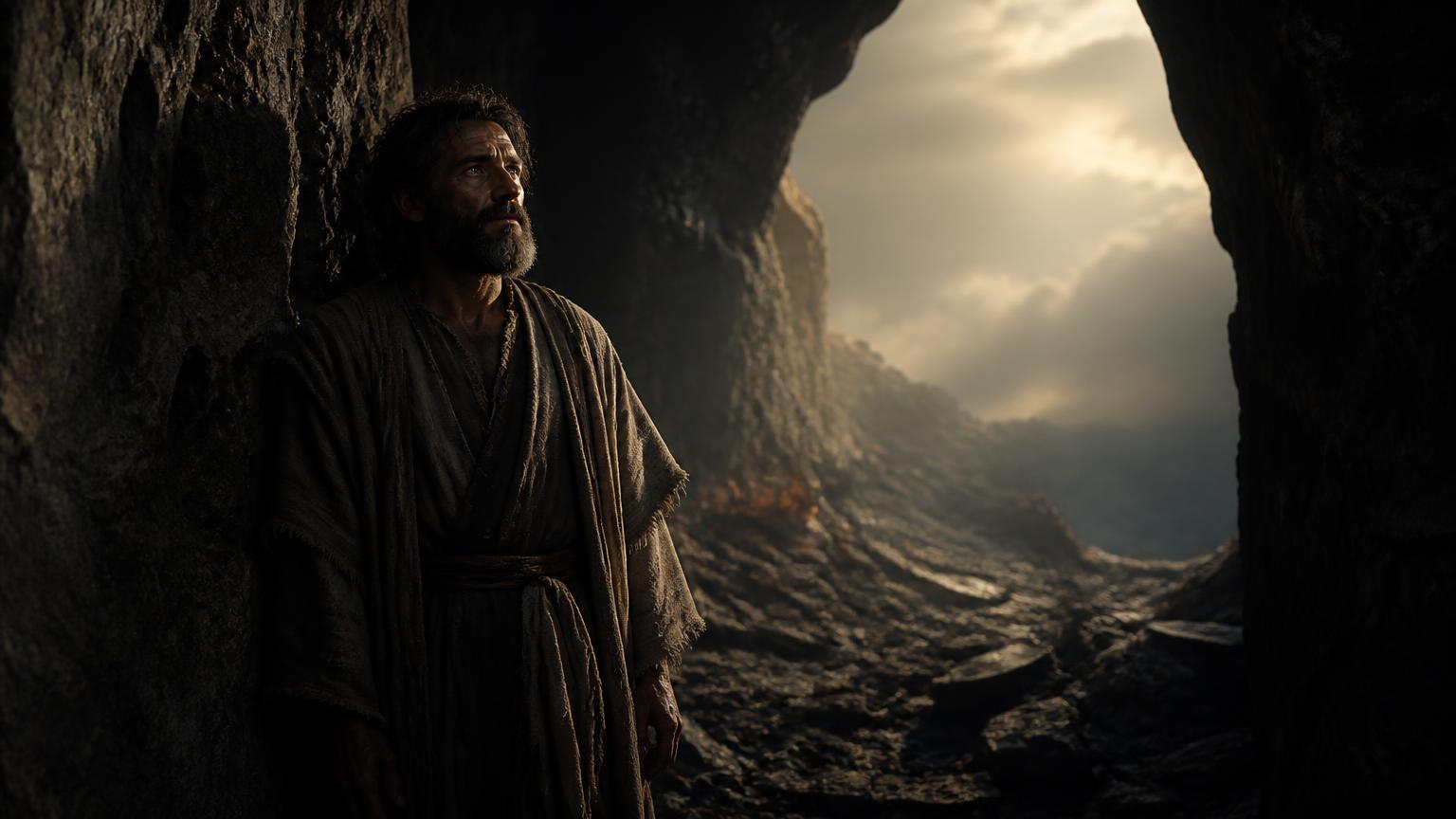
Elijah eventually walked for weeks to a mountain and slept in a cave. For a long stretch, the God he’d spent his life speaking for said nothing.
Before he got answers, he got a nap and a meal
This is the part that seems to disappear from nearly every sermon about Elijah.
He fell asleep. Something woke him gently, and there was bread and water. He ate, then went back to sleep. Later, he was woken and fed again.
No lecture. No get up, you’re being dramatic. No attempt to explain the spiritual meaning of his collapse.
Bread. Water. Sleep. Then the same thing again.

Only after all of that does the story move forward.
Whatever you make of that account, it’s an odd detail to include if the point is supposed to be spiritual performance.
Sometimes what feels like spiritual silence is a body running on empty. Grief flattens everything. Exhaustion does too. Depression can mute your sense of God in much the same way it mutes music, food, pleasure, and any clear picture of your future.
If the quiet has been pressing down on you for a while, talking with a therapist or doctor isn’t a failure of faith. It’s the bread-and-water part. We keep a short list of places to begin when life becomes heavier than an article can carry. Reaching out to one of them may be one of the strongest things you do this week.
What finally showed up at the cave wasn’t what he ordered
Elijah is told to stand outside the cave.
A wind tears through the mountain, strong enough to break rock apart. The text says God wasn’t in the wind. Then comes an earthquake. God wasn’t in the earthquake. Then fire. Not in the fire either.
After that comes something the old Hebrew describes with a phrase translators still argue over—something like a thin, crushed quiet.
And after the fire came a gentle whisper.
Some translations render that same line as the sound of sheer silence. That’s how close the two are. When the presence finally came, it was almost indistinguishable from the absence.
I won’t turn that into a tidy promise that your silence is secretly full. I don’t know that. But it does suggest that loud and there aren’t the same thing.
Maybe we spend so long waiting for the earthquake that we miss what barely rises above the quiet.
And when the voice comes, it doesn’t correct Elijah. It asks a question: What are you doing here? It’s an opening, not an accusation.
Elijah responds with a complaint. He says he’s the only one left and that they’re trying to kill him too. His account isn’t entirely accurate, and he learns that later. But a few verses on, he repeats the exact same complaint, word for word, without editing it into something more respectable.
Nobody tells him to say it nicer.
The most famous prayer in this whole story is an accusation
Centuries later, a man is dying on a Roman cross outside Jerusalem. The words that come out of him are a quotation from a much older song: My God, my God, why have you forsaken me?
Forsaken means abandoned. Left. Walked away from.
Whatever you currently think about Jesus—believer, ex-believer, curious, done—notice what the story preserves. The central figure of this entire religion dies with an unanswered question on his lips.
The people who wrote the account could have left that part out. They didn’t.
So if you’re afraid your anger or doubt has disqualified you from the conversation, the text itself pushes back. The question of whether doubt disqualifies you is answered by the way the story is told: one of the hardest things anyone ever said to God remains right there in the middle of it.
Some things the quiet might be
Hold these loosely. You don’t need to choose one tonight.
Sometimes silence is depletion. You’re too wrung out to notice much of anything, which makes it a body problem before it’s a God problem.
Sometimes it’s grief doing what grief does—turning down the volume on the whole world at once.
Sometimes what we call silence is an answer we don’t want, so we keep asking and hoping a different one will arrive.
And sometimes no reason is available yet. Pretending there is one only gives the uncertainty a nicer-sounding lie.
What to do with a silence that won’t lift
Keep talking anyway. You don’t have to be polite about it. Elijah repeated his complaint word for word, and nothing bad happened to him because of it.
Say the true sentence instead of the acceptable one: this is unfair, or I don’t know if you’re real, or simply where are you.
Lower the bar. One sentence a day, spoken in the car or typed into your notes app. It doesn’t have to become a spiritual practice. Think of it as leaving the door slightly open.
Take the bread and water seriously. Sleep. Eat something. Text one person who won’t rush to fix you.
Stop grading yourself on how prayer feels. Feeling nothing while you speak isn’t proof that you’re doing it wrong. It may only mean you’re tired enough—and honest enough—to stop pretending.
You’re allowed to stay in this part
Nothing in Elijah’s story rushes him. He gets weeks in the desert, a cave, two naps, and a complaint he’s allowed to repeat.
Wrestling isn’t the opposite of faith. Sometimes it’s what faith looks like when it refuses to lie about what it’s experiencing. The people who yell the loudest in these old accounts are often the ones the stories keep returning to.
Sometime before you sleep tonight, say the one honest sentence. The unedited one. You don’t have to be certain anyone is listening.
Caves stay dark almost all the way to the end. Then light reaches inside before you ever step out.
You don’t have to see it yet to still be on your way there.
Leave a Reply